


A Summer of Contrasts at Bowhayes Farm

There is never really a “normal” season on a farm.
After what felt like an endlessly wet start to the year, summer arrived — and then apparently forgot how to rain.
Wet, wet, wet became dry, dry, dry remarkably quickly.
For our campers and glampers, it has made for some glorious stays in the orchard: long evenings, warm days, clear skies and the sort of peaceful nights that remind us why people come to Bowhayes in the first place.
For those of us looking after the land and the trees, however, sunshine tends to be accompanied by rather more frequent glances at the weather forecast.

Camping and Glamping in a Very Dry Devon Summer
Our summer camping and glamping season has been excellent, with guests enjoying the orchard at its most settled.
The grass has changed from exuberant spring growth to a distinctly more summer appearance, evenings have stretched out and the orchard has become a lovely place simply to stop for a while.
The prolonged dry conditions have, inevitably, brought some restrictions. A fire ban has been necessary during the driest periods — not something we impose lightly, but a sensible precaution when grass, hedges and surrounding countryside become tinder dry.
Fortunately, sitting beneath an apple tree with a cold drink as the sun disappears over the orchard isn't a particularly poor alternative.
From Too Much Water to Not Enough
The weather provides an interesting backdrop to some of the work we've been doing through Farming in Protected Landscapes (FiPL), alongside National Landscapes and the Farming & Wildlife Advisory Group South West (FWAG South West).
Earlier in the year, water was very much about managing excess rainfall and run-off.
The new Devon slate surfacing around the nursery is designed not simply to improve access, but to help hold rainfall and release it more slowly. We've also introduced an aerator and grassland subsoiler to improve the way water moves into and through the ground rather than racing across its surface.
After such a dry summer, talking about flooding can feel slightly perverse.
But that is increasingly the challenge: making the farm more resilient to both extremes.
Making More Room for Wildlife
Other FiPL work is becoming part of the landscape too.
Bee logs, bug hotels, bird and bat boxes, reptile refugia and hibernacula have all been installed around the farm, adding habitat alongside the mature trees, hedgerows, orchard and green lane already here.
Some will be occupied quickly. Others may sit apparently unnoticed for quite some time before the right resident discovers them.
Our barn owl box remains a case in point.
We continue to live in hope.
The rest of the wildlife has been rather less hesitant. Birds and pollinators have been plentiful, foxes continue to make themselves known and the deer are very much part of the landscape — occasionally rather more closely involved with our tree-growing activities than we might ideally choose.

A Little Encouragement from the Judges
This summer we were also fortunate enough to be selected as a finalist for the Devon Bronze Otter Award.
We didn't win — congratulations instead went to John Malseed of Frenchbeer Farm — but the feedback from the judging visit was enormously encouraging.
The judges recognised the direction of the farm: bringing together the orchard, nursery and visitor side of Bowhayes while improving soil health, reducing run-off, extending wildlife habitat and planning for the long term. They also picked up on something that matters greatly to us — sharing what we're learning with customers, visitors and the wider community.
There is plenty still to do, but sometimes it is useful to have somebody from outside the farm say that you're heading in the right direction.

Meanwhile, in the Orchard…
The cider apples have carried on remarkably well through the dry weather.
Sugar levels are building nicely, which is encouraging as we begin looking towards harvest.
The slight sting in the tail is juice.
Fruit can have plenty of sugar but, after a prolonged dry spell, less juice than we would ideally like. And when cider apples are sold by weight rather than by their sugar content, that becomes more than an academic observation.
We could therefore do with some sensible rain.
Preferably overnight.
For about three days.
And then it can stop again.
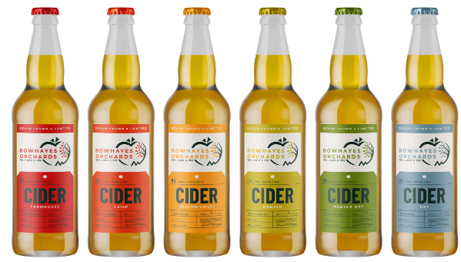
Bowhayes Cider Is Getting Closer
Our own cider project is also moving forward quickly.
It's one of those ideas that has spent a long time progressing behind the scenes — from growing the apples and thinking about heritage varieties through to the rather less romantic business of branding, labels, compliance and getting everything properly ready.
We are now getting tantalisingly close to having something finished to share.
Appropriately, it starts with the orchard itself.
Planting for the Future
Plans for our new heritage orchard are progressing too.
The aim is to concentrate particularly on traditional South West apple varieties, planted in a more traditional, lower-density orchard style.
This isn't about chasing the maximum possible number of trees into an acre. It is about creating something with longevity: productive trees, space beneath and between them, greater habitat diversity and a landscape that feels like an orchard rather than simply a crop.
Further FiPL and National Landscapes work is progressing alongside those plans, continuing the gradual process of improving the farm for production, wildlife, water and people.
And So the Seasons Roll On
That is probably the best description of Bowhayes at the moment.
Camping and glamping guests enjoying the sunshine. Apples quietly accumulating sugar. Trees and shrubs needing rather more water than we'd like. Wildlife finding newly created corners of the farm. Cider edging closer to reality. And new orchards being planned for people who may be walking through them many decades from now.
After a sodden spring and a parched summer, we're reminded again that farming is largely about working with whatever the season decides to give you.
Although, at this particular moment, a decent night of rain would be gratefully received.

Comments